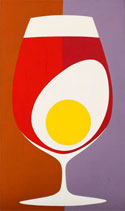
“Art isn’t a commodity. It’s non-utilitarian, but it’s useful because it makes everybody grow… Art should be seen and known and talked about. I’m operating on that basis.”
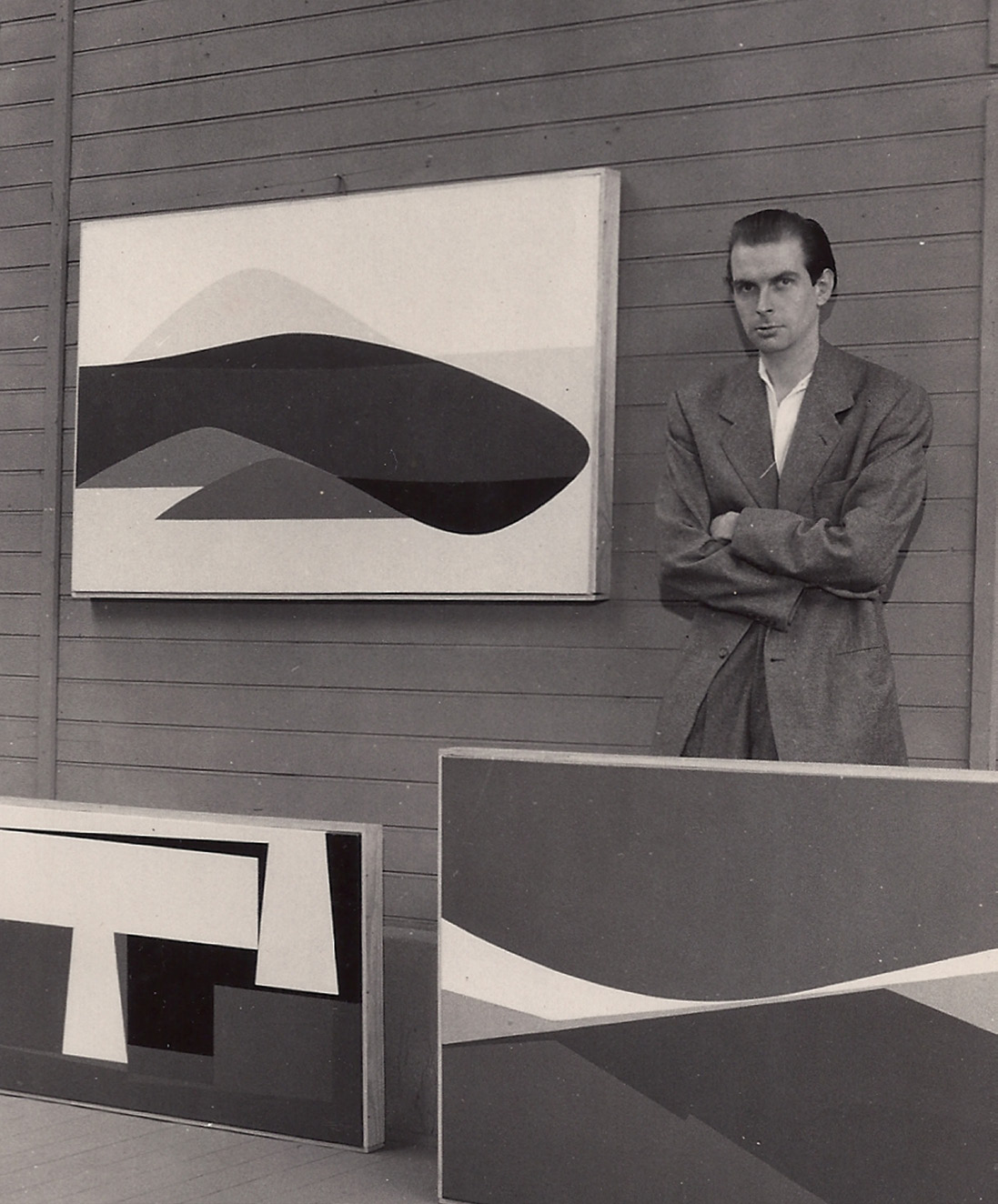
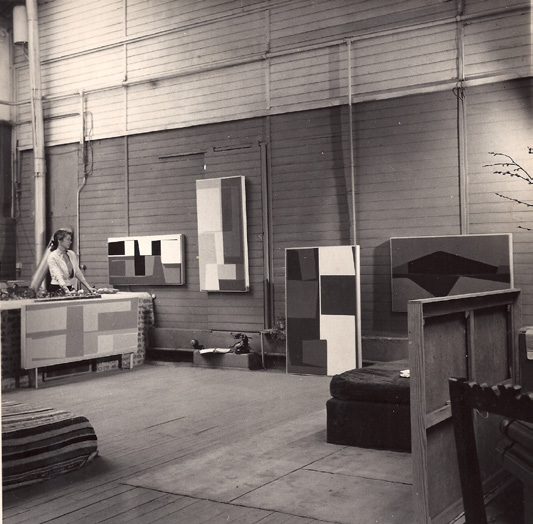
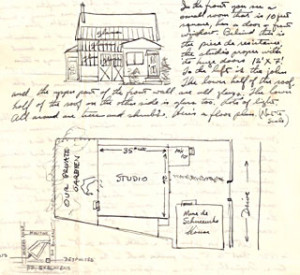
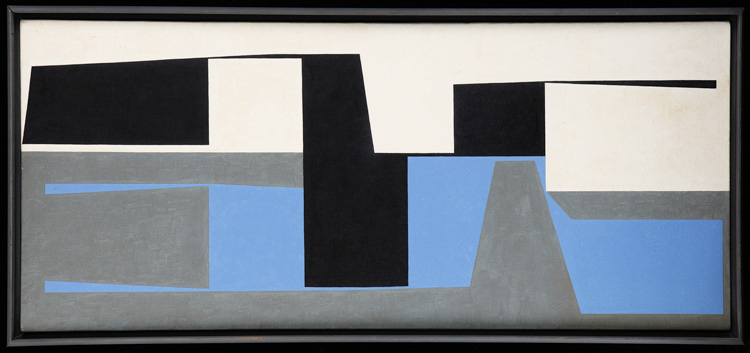
In April of 2008, Leo Zimmerman passed away. It had been nearly two decades since his last public show, but his studio in Old Louisville revealed a man busily toiling away, tirelessly charting the progress of an ever-evolving visual manifesto. Years of exploration in the field of geometric abstraction were informed by Zimmerman’s diverse array of endeavors in typography, mechanics, graphic design and entrepreneurship. The resulting artistic style synthesized the aesthetic of non-representational, hard-edged shapes and aggressive color with a philosophy of invention.
Zimmerman — who later took up the pseudonym Leo Wrye as a reference to both a favorite drink and his own contrary sense of humor — felt art was vital to the well-being of societies. After returning from Paris in the 1950s he spent years invigorating the local arts community, helping to instigate what was hailed as a cultural renaissance for Louisville, before dropping out of the public spotlight entirely.
Even during his reclusive years, his orientation towards process compelled him to create prolifically, pressing ever forward towards new ground. Instead of embracing the final products of his efforts as prized artifacts of artistry or invention, Zimmerman regarded these works as byproducts of discovery. But for viewers, they are road maps to self-realization; a carefully demarcated atlas to help unravel our own journey of seeing.
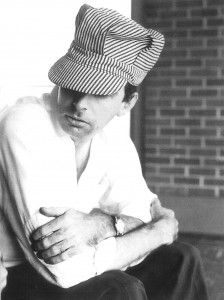
Leo Zimmerman was born in Timlin, Pennsylvania on September 21, 1924, but moved to his mother’s hometown of Louisville, Kentucky by the time he was five years old. After graduating from Male High School, he enrolled at Centre College in Danville, Kentucky, where he would ultimately volunteer for the army at the draft board in April of 1943.
For two years and fifty-two days, Wrye served in what he called “that great unpleasantness number two” (WWII), before being honorably discharged on VE-Day at Camp Atterbury, Indiana. Zimmerman’s original plan had been to study medicine and follow in his father’s footsteps — however, it was during his time in the army that he was first exposed to formal art training, at the Biarritz American University in France.
Upon his return to the U.S., Zimmerman enrolled at the University of Kentucky and majored in fine arts, graduating in the spring of 1948.

Judged that year by Katherine Kuh of the Art Institute of Chicago, the win came with prize money — and the prize money bought a ticket back to Paris, then the liveliest center of postwar art in the world.
Paris after the war was a thriving locus of artistic development, and Zimmerman dove in — diligently striving, by friend Joseph Fitzpatrick’s account, to produce a painting a week. Seeking entry to the avant-garde, the two young veterans knocked on the door of abstract artist Edgard Pillet, secretary general at the Atelier d’Art Abstrait, who welcomed them as mentor and collaborator.
Zimmerman mixed with artists such as Victor Vasarely — later celebrated as the father of Op Art — Jack Youngerman, Ellsworth Kelly and close friend, filmmaker Robert Breer. In February 1952 he was included in a six-artist exhibition at the storied Denise René gallery, drawing notice from critics at the New York Herald Tribune and the French art press.
He was invited to join La Groupe Espace, the Paris association of artists, architects and designers founded in 1951 — and asked to help establish its American branch.
“The Groupe Espace is an organization of artists and architects who are trying through common effort to bring a little closer relationship between the arts and their relation to la vie.”
“Pillet and Bloc… have ask me to become the American manager of [Art d’aujourd’hui] subscriptions in USA to spread the good word.”


To supplement the allowance provided by the G.I. Bill, Zimmerman took an entrepreneurial leap and began selling popcorn to a Paris public entirely unfamiliar with the white morsels of crispy cooked kernels. Alongside Edgard Pillet, he distributed his wares from the back of a beloved but dilapidated English pick-up truck to bars and grocery stands throughout the city.
He designed a sidewalk popcorn machine (and convinced a French firm to manufacture it), an industrial-size popper, and a bag sealer — the latter two installed in an abandoned sculpture studio that doubled as the young artist’s makeshift popcorn factory. Between the red tape of importing un-popped kernels from Davenport, Iowa and vendors stealing the profits, the operation eventually shut down. The old English pick-up was sold to Victor Vasarely for one hundred dollars’ worth of francs.
“I would rather paint for art than for people who like art because they think they ought to. I’ll keep on painting for art and make my living selling popcorn.”
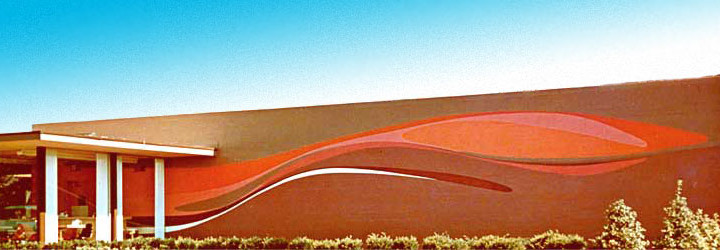
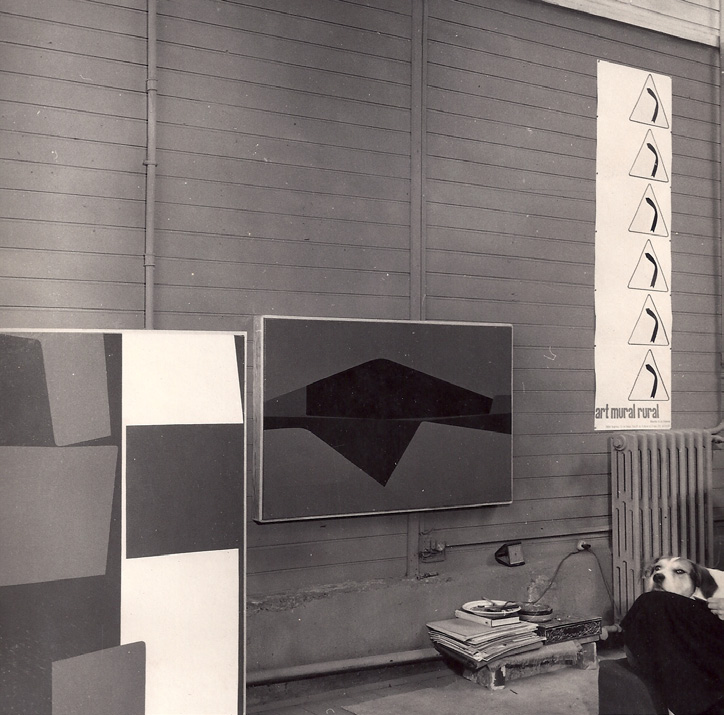
Conceived in 1952 after driving through the French countryside, the rural-mural combined Zimmerman’s geometric abstraction, aggressive color palette and sense of visual drama with his philosophy that art should be available to the public, enrich their experience, and enhance the beauty of public visual space. Where companies painted crude product lettering across whole barn sides — Mail Pouch, Bull Durham, Jefferson Island Salt — Zimmerman saw canvases.
In 1956 the vision came to life, only in a more suburban environment: a drive-in restaurant on Shelbyville Road owned by arts patron Austin Pryor, designed by architect Norman Sweet, who called with Pryor’s request — “Could a rural mural become suburban?” The completed mural ran sixty-seven feet long and thirteen feet tall, gracing U.S. 60 for five years before an expansion of the building obscured it from view. Pryor also commissioned a forty-foot rotating hamburger sculpture for another restaurant.
“These ads are only ugly colored letters giving the name of the product… a blight to the landscape. I have hit upon the marvelous idea of utilizing these huge surfaces for art. And art which will serve the second purpose as advertising.”
“I hope that this mural becomes more than a source of shock to the 45,000 or so daily passers-before-it; that it becomes an added excitement in the landscape.”


Zimmerman returned to the U.S. on July 4, 1953 — choosing Louisville over the New York path taken by contemporaries like Kelly and Youngerman — and set about revitalizing his hometown’s cultural life. He opened the Carriage House Art Supply Store and its art school, where a $13 starter kit drew roughly 500 amateur students within a year. In 1955 he founded Arts in Louisville, a monthly magazine (later the fortnightly Gazette), with Paris mentor Edgard Pillet as adviser and contributor.
In late 1957 came the Arts in Louisville House at 519 Zane Street — a combined gallery, bar, theater, library, restaurant and office, serving croque monsieur out of the kitchen and world-class jazz off the bandstand. The House drew controversy for its racially integrated policies at a time when that was far from the norm — and drew Dizzy Gillespie, Cannonball Adderley, Max Roach and Josh White to its stage.
Chronologie — selected engagements, from A Wrye Life, Vol. III Book Two
By the mid-sixties Zimmerman had dropped out of the public art scene, though he stayed creatively active, working independently and collaborating with other local artists. In 1966 he was hired as physical facilities manager at the Louisville Free Public Library’s Main Branch at 301 York Street, where he worked until 1977.
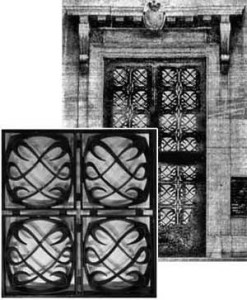
There he worked alongside prominent Louisville sculptor Barney Bright to produce a set of cast-aluminum door panels for the library — designed by Zimmerman, sculpted by Bright, composed of 32 panels, each bearing the double-“L” emblem of the library’s seal. Installed at the south entrance in 1970, the doors stood until renovations removed them in 1993.
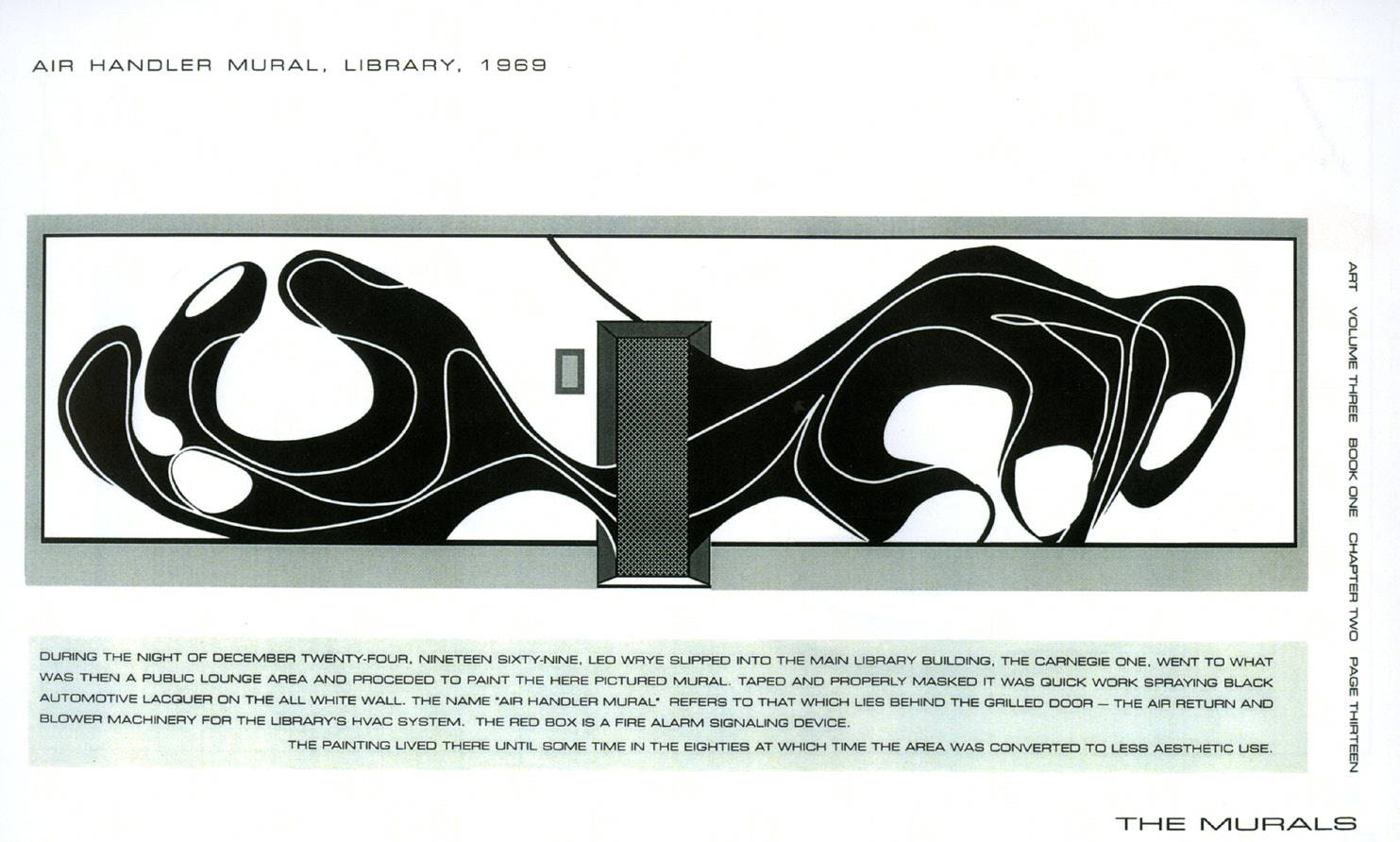
And on the night of December 24, 1969, Leo Wrye slipped into the main library building — the Carnegie one — taped, masked, and spray-painted a mural in black automotive lacquer across an all-white wall of the public lounge. He named it the Air Handler Mural, for the air-return and blower machinery behind the grilled door it surrounded. It lived there until sometime in the eighties, when the area was converted, as his book puts it, “to less aesthetic use.”


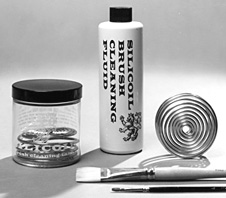
In 1954, dissatisfied with brush-cleaning systems that damaged paintbrushes during washing, Zimmerman developed an alternative device he named the Silicoil. Patented in 1962 and manufactured by the Lion Company, Inc. of Louisville, it remained one of the leading brush-cleaning systems on the market for decades — and it afforded Zimmerman the freedom to pursue his artistic vision without ever needing to sell a painting.
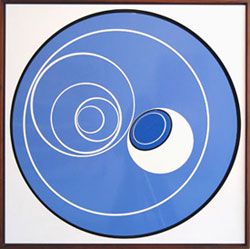
Its design is one variation of the swirling, spinning, rotating movements Zimmerman frequently used to explore relationships between forms. It is this series of concentric circles — manifested three-dimensionally in the elegant utility of the Silicoil, repeated in paintings such as Double Coil and Untitled #9, and evident in the rotating motion of the Slu Balls — that thematically unites Zimmerman’s visual vocabulary.
An inventor’s income for a painter’s independence: the coil bought him fifty years of refusing to sell.
The Slu Balls (also spelled “Slue”), or Lacquered Kinetic Paintings, were first exhibited at the University of Kentucky in 1989. Zimmerman believed that “painting is essentially an astonishing art of illusion,” and these works are his explorations in kinetic — moving, shifting — perspective.
Fabricated from lacquered aluminum sheets inlaid and mounted on a lacquered aluminum panel, each is driven by an electrical motor powering a turntable within a walnut frame. When the turntable begins its revolution, the elliptical discs appear to move not in a circle, but in and out and back and forth through space — a surprising display of optical trickery, built by mechanical means. He fabricated exactly twelve.
“Seeing, itself, is illusory. Perception is an intricate, complex process of integrating and interpreting visual experience. These paintings astonish via that process.”


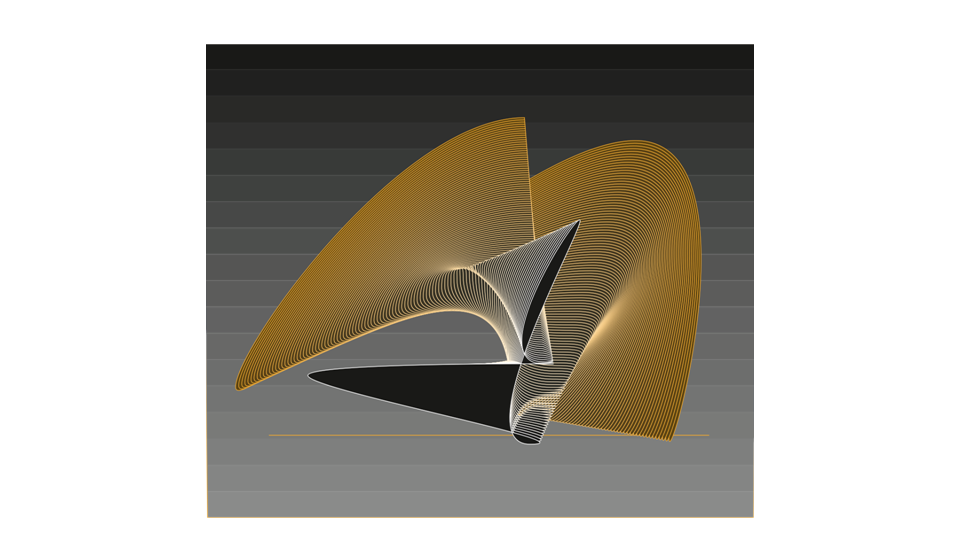
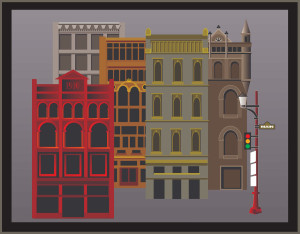
Deemed “Apple Art” because of their production on an Apple Macintosh Quadra 700, these abstract vector illustrations exhibit qualities found in Zimmerman’s earlier work — but with the added dimensions of time and motion. Created with a basic graphics program, Aldus FreeHand 3.1, and a digitizing tablet, the forms unfurl and evolve dynamically.
Zimmerman saw the vast potential of digital drawing very early in its development and adopted it enthusiastically, in his late sixties, as a medium for artwork. More than twenty-five Apple Art paintings are documented in A Wrye Life — and according to friends and family, he created approximately 2,000 in the years before his death.
The man who hand-lettered a magazine in 1955, cut aluminum in 1970, and machined turntables in 1989 spent his final fifteen years drawing with a stylus — the same geometry, one more new machine.


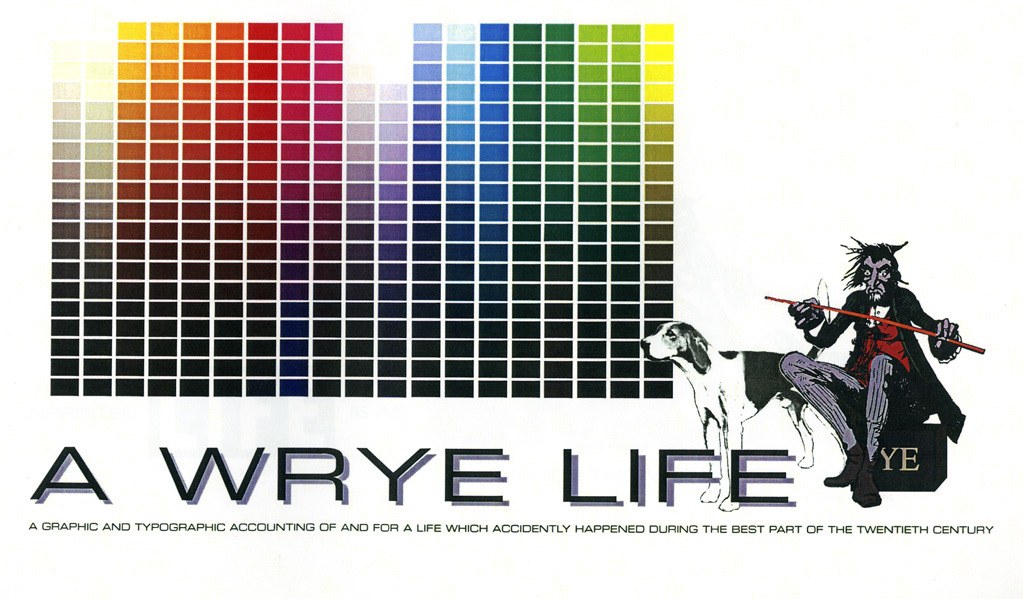
In 1993 Zimmerman began work on an autobiography. The book, titled A Wrye Life, grew to over 1,300 pages, and in addition to his art covers his interest in all things mechanical — power and painting tools, hound dogs, Mozart, custom-built automobiles, and hundreds of Wrye aphorisms, detailed and illustrated.
The book was supposedly written and edited by close friend Jean Phillipe Le-Seigleur — a fictional author with a background in engineering, invented by Zimmerman, who “became interested” in the Apple Art and set out to produce a biography, philosophy, gallery, and comprehensive archive of Zimmerman’s life. Though mostly accurate in its account of his artistic career, the book takes certain liberties with the truth: a creative reconstruction of a very wry life.


“I believe that art is the most important manifestation of human culture… There must be art; no culture has ever existed without it that has deserved to be called a civilization. There must be art, and to make arts there must be artists… Good form is a spiritual food that is as necessary to the spirit as potatoes to the stomach. Those who are deprived of it are starving.”
In 2011, researcher McKenna Graham curated Leo Wrye Zimmerman: Return to Main Street at the University of Louisville’s Cressman Center for the Visual Arts — drawing together surviving paintings, sculpture, the Silicoil, issues of Arts in Louisville, and material from Zimmerman’s widow Marie, his daughter Zaurie, the Lion Company factory, and the York Street library.
Graham’s argument is simple and overdue: Zimmerman deserves a real place in the history of American geometric abstraction. He worked alongside Vasarely and the figures central to that movement’s development — and his conviction that art should be woven into ordinary civic life, onto barn sides and drive-ins and library doors, remains a model for how a city’s arts community might organize itself.
He painted constantly and almost never sold. He turned down nearly every invitation to exhibit. He was driven by the process of discovery itself rather than by the finished object — an inventor’s temperament applied to painting. The works remain: road maps to self-realization, an atlas for unraveling our own journey of seeing.
“Art should be seen and known and talked about.”
In March 2024 the Grey Art Museum at New York University reopened at Cooper Square with Americans in Paris: Artists Working in Postwar France, 1946–1962 — some 130 works by roughly seventy artists, curated by Debra Bricker Balken with Lynn Gumpert. It was the first sustained reappraisal of the Americans who made their work in Paris rather than New York, and it reassembled the precise milieu Zimmerman had lived inside: Ellsworth Kelly, Jack Youngerman, Ralph Coburn, Shirley Jaffe — and Robert Breer, the filmmaker he counted a close friend. The exhibition travelled to the Addison Gallery of American Art in Andover that September.
Zimmerman’s work was among it — a late and improbable return to the city where he had made it. For a painter who refused nearly every invitation to exhibit and sold almost nothing in his lifetime, it is a rare instance of the work standing in public, on its own, beside the contemporaries it was made among.
The accompanying volume — three hundred pages, co-published by Hirmer and the Grey — is the closest thing the period has to a standard reference. Alongside an introduction by Gumpert, it carries essays by Balken, Rashida K. Braggs, Elisa Capdevila and J. English Cook on the Parisian salon system, the Black experience in postwar Paris, and the films that mythologised the expatriate years; an extensively illustrated chronology; and a set of interviews with the artists, dealers and critics of mid-century Paris, recorded by Billy Klüver and Julie Martin in the early 1990s and never published before.
It is one of the few places Zimmerman’s name reaches the wider record of the period — outside Louisville, outside the family archive, set among the artists he worked beside and argued with at the Atelier d’Art Abstrait.